Blog Summary:
Most companies don’t realize how much their contract process is costing them until something breaks. A renewal nobody caught. An approval that sat in someone’s inbox for two weeks. A vendor agreement nobody can locate. Manual contract tracking looks manageable until the volume hits, then it becomes a liability. This blog breaks down exactly where the money and time bleed out, what it does to legal, HR, and procurement, and why Contract Verse by Truecopy exists to close that gap.
Introduction
Spreadsheets. Shared drives. Email chains with subject lines like “Contract v3 FINAL revised.” If this sounds familiar, you already know the problem; you’re just not seeing the full cost of it yet.
Manual contract tracking works fine when a company handles ten contracts a month. Push that to a hundred, five hundred, or a thousand, and the cracks show up fast. Deadlines get missed. The wrong version gets signed. Someone’s waiting on an approval that got buried three threads deep. Nobody has a clear picture of where any given contract actually stands.
This isn’t a people problem. It’s a process problem. And unlike most process problems, this one has a direct, measurable cost attached to it — lost revenue, compliance exposure, and hours of work that shouldn’t be happening manually in the first place.
Common Problems with Manual Contract Tracking
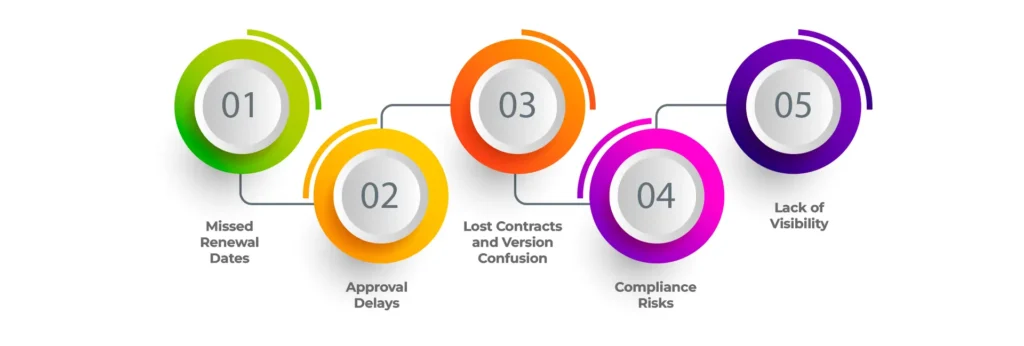
Missed Renewal Dates: Nobody sets a calendar reminder for 500 vendor renewals. Contracts expire quietly, and by the time someone notices, the relationship has lapsed, or the terms need renegotiating from scratch. With manual contract tracking, renewal management depends entirely on whoever remembered to follow up, which means it depends on luck.
Approval Delays: A contract goes out for approval. The approver is traveling. Their backup doesn’t know it’s waiting. Legal has no visibility. The deal sits for two weeks for no reason other than the process has no structure. This is one of the most common contract management challenges, and it’s entirely avoidable.
Lost Contracts and Version Confusion: Five versions of the same contract; three people made changes, nobody’s sure which one went out for signature. This is the version confusion problem, and it’s not rare. In companies using shared drives and email for manual contract tracking, it happens regularly — and when a dispute comes up, nobody can produce the right document quickly.
Compliance Risks: Contracts without proper audit trails are a compliance liability. If a regulator asks who approved a vendor agreement and when, “I think it was Akansha, check the email chain” is not an acceptable answer. Contract management challenges around compliance only grow as volumes grow.
Lack of Visibility: Leadership can’t see how many contracts are active, which ones are expiring, or where things are stuck. There’s no dashboard, no status update, no early warning. Decisions get made without complete information because the information doesn’t exist in any usable form.
Hidden Costs of Manual Contract Management
The obvious cost is time. But the real cost is what that time translates to.
Every hour a contract sits waiting for a signature is an hour before revenue gets recognized. Every missed renewal is a potential lost vendor relationship or a renegotiation that didn’t need to happen. Every compliance gap is a potential legal exposure.
Companies running manual contract tracking at scale are typically dealing with a combination of these losses simultaneously, and because each individual instance seems small, the total number never gets calculated. When it does, the case for digital contract management becomes hard to argue against.
Operational costs add up too. Someone is spending real time filing, chasing approvals, searching for documents, re-sending agreements, and following up on signatures. That time has a salary attached to it. Online contract management doesn’t just save frustration; it reallocates those hours toward work that actually needs human attention.
How Manual Tracking Impacts Legal, HR, and Procurement Teams
Legal teams carry the most risk. They’re responsible for compliance, audit trails, and making sure the right version of every contract is signed and stored. Manual tracking makes all three harder than they need to be. Legal ends up spending time doing admin instead of legal work.
HR teams deal with offer letters, NDAs, and employment agreements at volume especially during hiring seasons. Sending these out manually, chasing signatures, and storing copies in folders is time that scales badly. A single hiring push can overwhelm an HR team’s contract process completely.
Procurement teams manage vendor relationships that live inside contracts. Payment terms, SLAs, renewal dates, and if procurement can’t track these in real time, they’re negotiating blind. Vendor contract management done manually means someone is always working with incomplete information.
Manual Contracts vs Digital Contract Management: Complete Comparison
Area | Manual Process | Digital Contract Management |
Contract creation | Templates copied manually, errors common | Template-driven, auto-generated, consistent |
Approval routing | Email-based, no tracking | Automated routing with notifications |
Signing | Physical or untracked digital | Legally compliant eSign, full audit trail |
Storage | Shared drives, folders | Centralized, searchable, tagged repository |
Renewal tracking | Calendar reminders, if remembered | Automated alerts before deadlines |
Compliance | Inconsistent, gap-prone | Built-in audit trails, version control |
Visibility | None at scale | Real-time dashboards, status tracking |
Contract workflow automation wins on every dimension. The question isn’t whether it’s better; it’s how long companies can afford to wait before making the switch.
How eSigning Eliminates Contract Execution Delays
Printing, signing, scanning, emailing, or worse, couriering is a process that adds days to every contract that goes out. For companies managing volume, those days compound into weeks of delayed execution every month.
eSign removes that entirely. A contract goes out digitally, the signer receives it on their device, verifies identity through OTP or Aadhaar authentication, and signs. The signed document is timestamped, stored, and sent to all parties instantly. No printing. No scanning. No waiting for someone to be physically present.
Contract workflow automation built around eSign is what makes high-volume contract execution possible without scaling headcount proportionally. Legal teams that still rely on physical signatures for routine agreements are adding unnecessary time to every deal cycle.
How Delayed Contract Approvals Slow Revenue Growth
Every sales deal, vendor onboarding, or partnership agreement that sits waiting for a contract approval is revenue that hasn’t moved yet. When approvals depend on someone being available, checking their email, and responding without a deadline, the average approval time stretches out.
Multiply that by the number of deals in the pipeline at any given time, and the impact on quarterly revenue recognition is significant. Contract automation with defined approval chains and automated follow-ups cuts that approval time down without anyone having to manually chase anyone.
How Automated Alerts Prevent Contract Risks
The difference between a contract risk and a contract disaster is usually timing. Catch an expiring agreement 30 days out, and you have time to renew, renegotiate, or replace the vendor. Miss it entirely, and you’re either operating without a valid agreement or scrambling to fix it while the other party has leverage.
A proper contract management system sends alerts before deadlines, not after. Legal and procurement teams see what’s expiring, what’s due for review, and what needs action, all surfaced automatically, without anyone having to run a manual check.
Why Enterprises Are Adopting Contract Management System Platforms like Contract Verse
Contract Verse by Truecopy is a contract management platform built for companies that deal with contracts at real volume. It’s not a glorified storage tool. It’s a full contract management system that covers creation, collaboration, approval, signing, storage, and renewal in one connected system.
The Contract Verse contract management platform includes template-driven bulk contract generation; clause-level collaboration on drafts; automated approval routing; legally compliant eSign and real-time eStamp through NeSL integration; centralized document storage with smart search; and automated renewal tracking. All of it in one place, connected through REST APIs to ERP, CRM, and HRMS systems.
For enterprise contract management, this means contract workflows don’t sit in a separate tool. They become part of the systems teams already use. Legal, procurement, HR, and sales all work within a contract management solution that keeps everything visible, tracked, and compliant.
Contract Verse contract management solution also handles bulk contracts, generating a thousand dealer agreements from one template, routing them for signing, track completion across all of them. The kind of scale that breaks manual processes is exactly what the platform is built for.
The shift companies are making in 2026 isn’t just about efficiency. It’s about building a contract process that doesn’t create risk by existing.
FAQ
Manual contract tracking is the process of managing contracts through spreadsheets, email, shared folders, and physical documents without a dedicated contract management system. It works at low volumes but breaks down quickly as the number of contracts grows.
Missed renewals, version confusion, approval delays, and compliance gaps are all direct consequences of manual contract tracking. Without an audit trail or automated alerts, errors accumulate quietly and often only surface when they've already caused damage.
Contract automation removes the manual steps from contract creation, routing, signing, and tracking. Approvals go out automatically. Signatures happen digitally. Alerts fire before deadlines. Teams stop spending time chasing contracts and spend it on higher-value work.
Manufacturing, FMCG, real estate, finance, automotive, and HR-heavy industries all benefit significantly from digital contract management and contract workflow automation. Any business with high contract volumes or compliance requirements is a fit.
Contract Verse by Truecopy is a full contract management solution that covers every stage. Template-based creation, multi-party collaboration, automated approvals, eSign and real-time eStamp, centralized storage, and renewal tracking. It replaces scattered manual processes with one compliant, scalable system.
Conclusion
The cost of manual contract tracking doesn’t show up on one invoice. It shows up in slow deal cycles, missed renewals, compliance gaps, and the hours legal and procurement teams spend doing work a system should be doing. Individually, each one seems manageable. Together, they add up to a real drag on business performance.
Contract Verse by Truecopy is the contract management platform that replaces all of it. Every contract, every stage, every team, inside one system that keeps things moving without the risk that comes with doing it manually.
The companies switching to online contract management and proper contract management platforms this year aren’t doing it because it’s trendy. They’re doing it because they finally added up what the old way was actually costing them.