In today’s digital world, paper is taking a back seat. Whether you’re closing a deal, onboarding a new employee, or signing a rental agreement, chances are you’re doing it electronically. Signing documents online is no longer a futuristic concept—it’s our reality. With the surge of online signing tools, businesses and individuals alike are onboarding with the convenience and efficiency of this approach.
But while it seems simple, questions often arise: Are electronic signatures truly legal? Are they safe? Do they hold the same weight as traditional ones? In this blog, we’ll answer the 6 most frequently asked questions about online document signing and provide the clarity you need to navigate this modern convenience with confidence.
Is an electronic signature legally binding?
Yes, an electronic signature holds legal binding in most countries, including the U.S., the EU, and many others. Laws such as the U.S. ESIGN Act, the Uniform Electronic Transactions Act aka UETA, and the EU’s eIDAS regulation recognize the legal validity of e-signatures. These laws state that a signature cannot be denied legal effect just because it’s in electronic form.
When using TRUESigner ONE, your e-signature complies with global regulations, ensuring that your signed documents are legally sound.
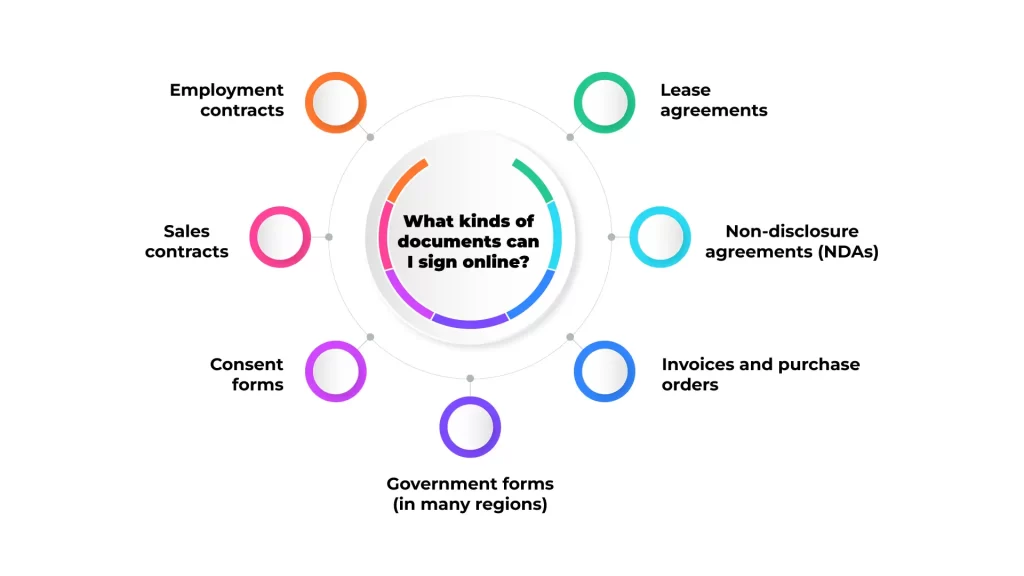
What kinds of documents can I sign online?
Almost any document that traditionally requires a handwritten signature can now be signed online. This includes:
- Employment contracts
- Lease agreements
- Sales contracts
- Non-disclosure agreements (NDAs)
- Consent forms
- Invoices and purchase orders
- Government forms (in many regions)
Online signing tools like TRUESigner ONE allow you to sign documents online effortlessly, offering templates and integrations that make the process seamless across industries.
How secure are online signatures?
Secure document signing is a top priority for trusted platforms. Online signatures are protected with encryption, audit trails, timestamps, and identity verification tools. This ensures the document has not been altered after signing.
With TRUESigner ONE, every electronic signature is backed by security protocols, including two-factor authentication and blockchain technology, making your online signature safe and tamper-proof.
Deconstruct the difference between a handwritten signature, a digital signature, and an electronic signature?
Let’s break this down:
- Handwritten Signature: Your traditional pen-on-paper signature.
- Electronic Signature: Any symbol or process used to sign a document electronically. This includes scanned signatures, typed names, or drawing your signature on a touchscreen.
- Digital Signature: A particular kind of electronic signature that uses cryptographic algorithms for greater security and authentication. It’s verifiable, unique, and prevents tampering.
Platforms like TRUESigner ONE offer both simple and advanced electronic signature capabilities, depending on your security and compliance needs.
Should my electronic signature be identical to my handwritten signature?
Not necessarily. While some people prefer to replicate their handwritten signature digitally for familiarity, it’s not a legal requirement. What matters is your intent to sign and the ability to verify that intent. Online signing tools usually offer multiple ways to personalize your electronic signature, including uploading images, drawing with a finger or mouse, or typing your name in various fonts.
With TRUESigner ONE, you have the flexibility to choose what best represents your identity.
Can I sign a document online from any device?
Absolutely. One of the most prominent advantages of signing documents online is device compatibility. Whether you’re on a desktop, tablet, or smartphone, most modern platforms are optimized for all screen sizes. This enables on-the-go signing without needing to print, scan, or fax anything.
TRUESigner ONE ensures a smooth, responsive experience across devices, helping you complete tasks in minutes, not hours.
Frequently Asked Questions (FAQ)
Signing documents online is highly secure, especially when using platforms like TRUESigner ONE. Features such as encryption, audit logs, and identity verification ensure secure document signing that meets legal and compliance standards globally.
Verification typically involves checking the audit trail, time stamps, IP addresses, and digital certificate associated with the signature. Some platforms use blockchain for added transparency. TRUESigner ONE includes verification tools that make authenticity easy to prove in legal or business scenarios.
Virtually every industry now uses e-signatures, including:
- Real Estate
- Legal
- Healthcare
- Finance and Banking
- Human Resources
- Government Services
These sectors benefit from faster workflows, improved customer experiences, and reduced operational costs thanks to online signature solutions.
Can I decline to sign electronically?
Yes, you can. While electronic signatures are legally binding, you are not obligated to sign electronically unless you consent. In many jurisdictions, alternative signing methods must be made available upon request. However, with the convenience, speed, and security of platforms like TRUESigner ONE, most users prefer the electronic route.
Summing up
The way we handle paperwork is changing—and for the better. With tools like TRUESigner ONE, signing documents online has never been easier or more secure. Whether you’re signing a lease, closing a deal, or submitting HR paperwork, using an electronic signature saves time, boosts efficiency, and offers peace of mind.
To recap:
- Electronic signatures hold legal binding and wide acceptance
- You can sign documents online from virtually any device.
- Secure document signing is made possible through encryption and verification.
- There’s no need for your e-signature to match your handwritten one.
- Multiple industries rely on digital signatures and online signing tools like TRUESigner ONE to get work done faster.
Make the smart switch today, and simplify how you sign documents online—with confidence.