Blog Summary:
Electronic signatures have shown themselves to be a fundamental component of contemporary business practices, facilitating increased operational efficiency, remote work capabilities, and the reduction of paper-intensive procedures. Nevertheless, quickness and convenience alone do not suffice to render a digital document legally enforceable. The true measure of an electronic signature’s validity is the integrity of its accompanying audit trail.
An audit trail serves as an unobtrusive record of each registration event. It documents the methods of document creation, the individuals who accessed it, the processes used for identity verification, and the timestamps of each action. In legal, regulatory, or compliance contexts, this trace becomes the most critical element in establishing authenticity and intent. This blog examines the importance of audit trails for legal validity, their typical contents, and how enterprise platforms such as TRUESigner ONE facilitate trust, compliance, and accountability.
As organizations advance their shift toward paperless processes, the electronic signature has transformed from a mere convenience into an essential business requirement. Contracts, employment correspondence, financial authorizations, and vendor agreements are now regularly executed electronically. Although this transition enhances efficiency, it also prompts a significant question: how can a digital signature be regarded with the same level of trust as a handwritten one?
The audit trail has the solution. Unlike conventional signing methods, which depend on physical presence or handwriting authentication, an Electronic Signature relies on system-generated evidence. This evidence is documented via an electronic signature audit trail that records all interactions with the file from inception to completion. Without this audit trail, even the most sophisticated electronic signature solution may face difficulties in withstanding legal or regulatory scrutiny.
Understanding Audit Trails in Electronic Signatures

An audit trail is a persistently maintained digital record that documents the entire lifecycle of a document. From the instant that a file is published until it is signed and finalized, each action is meticulously recorded and time-stamped. This encompasses signer verification, document access, activity monitoring, and the precise instant of signature.
Within an electronic signature environment, audit trails serve to remove ambiguity. They address essential inquiries, including the individual who signed the document, the method used to verify the signer’s identity, and whether the document remained unaltered following the signature. This is the reason why contemporary electronic signature solutions regard audit trails not merely as an optional feature but as an essential element of trust and accountability.
Why Audit Trails Matter for Legal Validity
Legal enforceability is contingent upon the presentation of evidence. Courts and regulatory agencies necessitate explicit evidence that a signer intended to sign, was appropriately authenticated, and that the document remains unaltered. An electronic signature audit trail offers this evidence in a structured and verifiable format.
From a legal standpoint, eSignatures serve to reconcile the divide between digital technology and conventional contract law. It creates an evidentiary record that substitutes for physical witnesses and handwritten confirmation. In disputes, the audit trace serves as the definitive source of truth, providing objective data rather than subjective interpretation.
This is the reason why eSign Audit Trails are becoming more frequently cited in legal proceedings and regulatory assessments. They mitigate uncertainty and enhance confidence in digital agreements.
What an Electronic Signature Audit Trail Includes
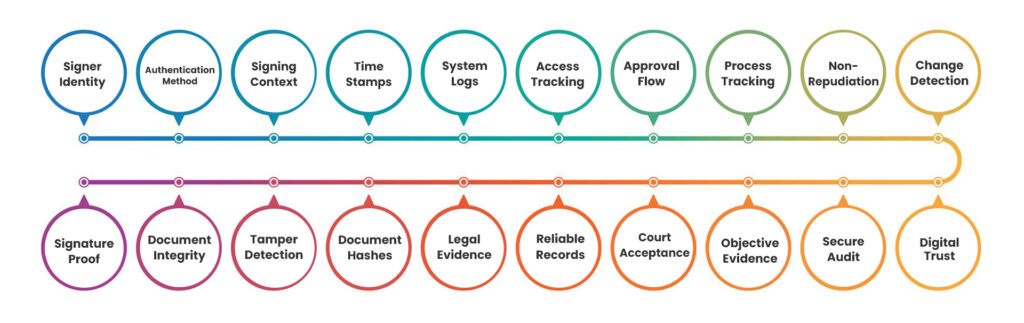
A thorough audit trail includes much more than just a “signed” status. It comprises each signer’s identity, the authentication technique used, and the context in which the signing happened. Time stamps indicate when the document was transmitted, read, and signed, while system logs show if it was accessed or changed at any point.
Advanced electronic signature solutions also track process activities, displaying how a document progressed via approvals and signings. This degree of information protects the signature process’s integrity and reliability in both internal audits and external legal procedures.
One of the primary functions of an audit trail is to ensure non-repudiation. Simply put, non-repudiation implies that a signer cannot subsequently deny having signed a document. This guarantee is crucial for any legally binding electronic signature procedure. Audit trails provide non-repudiation by combining signer identities, authentication processes, and timestamps into a single, verifiable record.
Security and integrity are equally crucial. Audit trails assist in ensuring that a document has not been changed after signing. By capturing document hashes and system events, they may identify tampering while preserving the original information. In legal disputes, these records serve as crucial evidence, indicating that the signed document remains precisely as it was at the moment of execution.
Courts are increasingly relying on eSign Audit Trails and system logs to determine the trustworthiness of digital agreements. This is why, in court, eSign Audit Trails are often recognized as more reliable evidence than handwritten signatures, which may be subjective or falsified. A secure audit trail converts an electronic signature into a legally acceptable activity supported by objective evidence.
Audit Trails in Real Business Workflows
Documents seldom involve only a single signer. Contracts may necessitate approval from legal teams, finance departments, human resources managers, and external partners. Each stage introduces additional complexity, and every action must be meticulously monitored.
This is the point at which a comprehensive Electronic Signature solution demonstrates its true worth. By recording each workflow event, the electronic signature audit trace offers comprehensive visibility across departments and locations. It enables organizations to demonstrate compliance with policies, proper adherence to assigned responsibilities, and that approvals were obtained in the correct sequence.
Such transparency is essential in regulated industries, where maintaining audit readiness is mandatory.
Audit traces have emerged as an essential foundation for establishing trust in routine business activities. In human resources, audit traces facilitate large-scale processes, including offer letters, induction documentation, and policy acknowledgements. Every action—ranging from document issuance to final approval—is meticulously recorded, enabling HR teams to substantiate compliance and address disputes concerning employment conditions or schedules.
In legal and corporate contexts, audit traces assume an even more crucial role. Contracts, agreements, and amendments frequently require the review and approval of several parties. A comprehensive electronic signature audit trace documents the entire lifecycle of these records, guaranteeing transparency and accountability at each phase. This degree of traceability is crucial during internal contract reviews or external challenges.
Finance and procurement departments also depend significantly on audit trails to uphold governance. Authorization for payments, vendor agreements, and financial approvals must adhere to rigorous procedural protocols. Audit traces guarantee that each approval is properly documented and verifiable, thereby minimizing the risk of unauthorized activities. Across various sectors, the audit trail has established itself as the essential foundation enabling Electronic Signature procedures to expand while maintaining strict control and compliance.
Legal Recognition and Court Acceptance
One of the primary concerns organizations frequently express is whether digital signatures will be legally valid in court. The response primarily hinges on the integrity of the audit trace.
In eSignature Audit Trails in Court, judges and legal professionals depend on audit records to substantiate authenticity and intent. A thoroughly documented trace substantially diminishes the likelihood of a signature being contested. Conversely, inadequate or incomplete documentation may compromise an otherwise valid agreement.
This is why organizations should select an eSign Service Provider that emphasizes audit integrity and adherence to compliance standards.
Regulatory compliance remains a primary catalyst for the extensive implementation of audit traces. Laws regulating the use of electronic signatures highlight the importance of transparency, verification of identity, and proper record retention. Audit trails directly support these requirements by providing a complete and auditable history of signing events.
In regulated industries, compliance investigations frequently necessitate that organizations demonstrate not only that documents have been signed but also that they have been signed appropriately. Audit traces allow organizations to fulfill these requirements without the need for manual effort. They provide clear evidence of adherence to internal policies and external regulations, reducing the burden of compliance reporting.
The principle of the propriety of audit trails and eSignatures is now widely recognized and established across various jurisdictions. Regulatory authorities and auditors anticipate that electronic records are as dependable as corporeal records, if not more so. By maintaining secure, time-stamped audit logs, organizations can confidently demonstrate compliance and governance in a digital-first environment.
How TRUESigner ONE Strengthens Audit Readiness
TRUESigner ONE is a software application that is developed for businesses that demand more than the fundamental signature capabilities. While maintaining a consistent and safe audit framework, it enables many kinds of electronic signatures, such as those based on Aadhaar, public key infrastructure (PKI), hardware security module (HSM), and digital signature certificates (DSC).
Every document that is signed using TRUESigner ONE is accompanied by a comprehensive audit trail that records the authentication stages, workflow activities, and system-level security checks that were performed. In order to ensure that businesses are always ready for audits, disputes, or regulatory assessments, this data is maintained in a convenient and secure location and can be retrieved with ease.
TRUESigner ONE gives organizations the opportunity to safely implement electronic signature solutions without losing legal certainty. This is accomplished by integrating scalability, compliance, and traceability.
Audit Trails and System Integrations
Integration of electronic signatures with preexisting enterprise resource planning (ERP), customer relationship management (CRM), or human resources (HR) systems is often required by modern businesses. When working in such contexts, it is even more important to ensure that audit integrity is maintained.
It is possible for activities to originate from other systems when using API-driven signing; however, the audit trail must be consistent throughout. Platforms such as TRUESigner ONE guarantee that the audit trail of the electronic signature is constantly collected and retained, regardless of the location from which the signing is started.
Automation is supported by this seamless connectivity, which also helps to manage compliance and traceability concerns.
Conclusion
The use of electronic signatures has fundamentally altered the way in which companies function; yet, the proof that supports them is where their actual power rests. This proof is provided via audit trails, which provide openness, accountability, and legal defensibility; they also give evidence.
The selection of an electronic signature system that has robust audit capabilities is of utmost importance for firms that are expanding their digital activities. In order to provide a legally acceptable, enterprise-grade digital signature, TRUESigner ONE illustrates how secure processes, compliance-ready design, and extensive audit trails can work together to support digital signing.
When it comes to a world that prioritizes digital technology, audit trails are more than simply documents; they are the basis of confidence.
FAQ
The term "audit trail" refers to a digital record that chronicles each and every stage of the electronic signature process. This includes the signer's identity, authentication, timestamps, and document activity.
Due to the fact that audit trails provide evidence of authenticity, intent, and integrity, they are vital for the purpose of ensuring legal enforceability and regulatory compliance.
It contains information about the signer, authentication mechanisms, timestamps, IP addresses, and data about the workflow history, all of which work together to authenticate the signature process.
Although this is true, the credibility of the document in legal proceedings is substantially bolstered by the presence of a full audit trail.
Yes. Audit trails are legally valid and may be used in court when they are made by a compliant eSign Service Provider.