Blog Summary: Traditional real estate closures have typically been awkward, slow, paper-heavy, and likely to face delays. Now that electronic signing solutions like TRUESigner ONE have been developed and are in widespread use, real estate firms are changing the way they do business, shortening closing times, maximizing compliance, and creating a better experience for their clients. This blog post discusses the challenges in the legacy closing workflows, the legal validity of electronic signatures in India, and how real estate organizations are adding the option for digital signs to their portals and into their CRMs. We will discuss compliance and convenience to explain why TRUESigner ONE is more than a signature tool; it’s an intelligent way to invest in growth.
In real estate, time is a deal killer and paperwork can take time. From missing signatures to courier delays, the way we used to close property deals isn’t working any more. This is why elite real estate firms are switching from pen and paper to eSigning tools like TRUESigner ONE to accelerate closures, minimize errors, and maintain competitiveness in an increasing digital-first market.
Challengesin Traditional Real Estate Closures
In traditional real estate closures, paperwork is typically the greatest hurdle. Agents spend far too much time chasing physical signatures on agreements, registration forms, and compliance documents. In situations with multiple parties, especially with NRIs or remote clients – delays can extend to days and weeks.
The risks caused by manual processes: lost papers, pages signed and missed deadlines typically accompany past systems. Real estate firms face challenges with physical file management, compliance, overseeing finance, and moving deals ahead in time. They struggle at times just to track progress or ensure the accuracy of agreements without a digital signature for real estate documents on their part to utilize.
Speed matters in today’s market; so, does trust. The past way of doing things has simply impeded firms. That is why many are realizing a switch to real estate document signing software will allow them to advance many tasks, including the closure process.
Advantages of eSigning for Real-Estate Companies
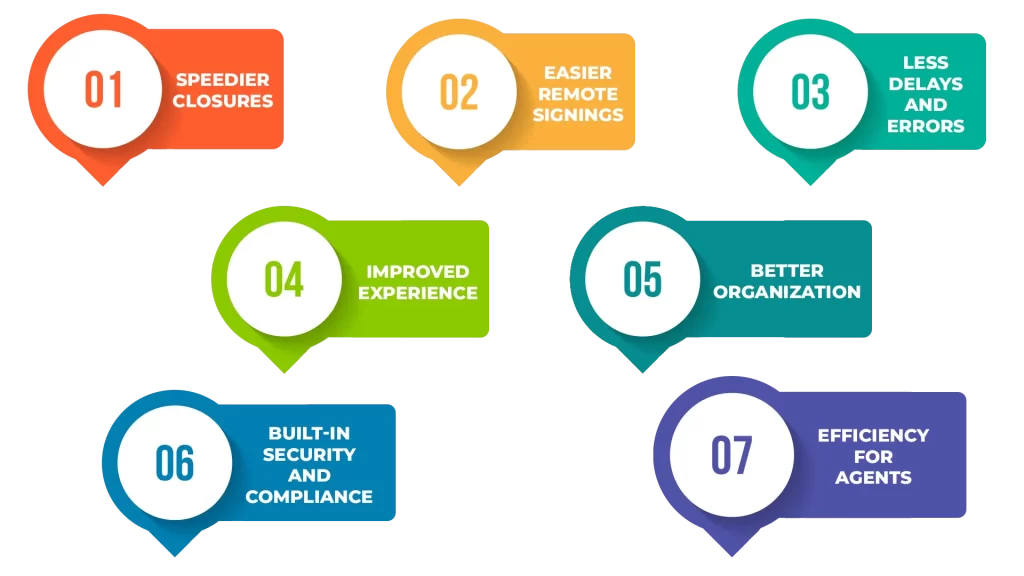
- Speedier Closures: An eSignature for real estate meansfirms can close deals in hours versus days, and no longer will have delays from couriers or scheduled in-person signings.
- Easier Remote Signings: Clients can sign documents online securely from anywhere – whether they’re local buyers or NRIs.
- Less Delays and Errors: eSigning removes uncertainty from missing a signature, using old forms, or failing to mark paperwork as complete – and your paperwork is all digital.
- Improved Experience: No printing, no scanning – just a professional and smooth signing experience that lives up to our modern expectations.
- Better Organization: Following the digital workflow, real estate teams will never have to deal with boxes of paper. Everything is stored and searchable online for future use.
- Built-in Security and Compliance: Hosted products, like TRUESigner ONE, capture audit trails and encrypt documents, providing firms with measures needed to comply with legal and regulatory obligations.
- Efficiency for agents: eSignature software for real estate agents meansfirms can save time – no unnecessary paperwork, relying on human error, wasted time or an inability to handle the file without physically closing it – and move on to closing any new deals.
Is eSigning legally valid in real estate?
A question that many firms always have before going digital is: Are eSignatures legally valid in real estate transactions? In short: yes, Electronic signatures in real estate transactions can happen completely legally in India as long as you follow the guidelines from the IT Act, 2000.
A good example of this is Aadhaar-based eSignature for the real estate industry—Aadhaar is accepted everywhere for signing sale agreements and lease contracts, as well as other key documents like Memorandums of Understanding (MOUs), joint ventures, and sale deeds. The electronic signature would be legally-binding so long asthe clear consent and identity verification are left intact.
This is why the wave of firms are increasingly trusting platforms like TRUESigner ONE to sign electronic contracts.
Real estate digital signatures create an audit trail and saves time. This can have value in helping to resolve disputes. Especially when you also consider the contractor’s need to prove compliance. For agents doing business at higher value transaction levels are likely getting a reasonable layer of required protection when using the best electronic signature for real estate.
All in all, an e signature for realtors isn’t just efficient; they are 100% legal as long as it is done right.
Connecting eSign with Real Estate CRMs and Portals through API integrations
When managing a quickly-moving real estate business, switching between tools is a barrier. Smart firms embed electronic contract signing into their CRMs and property portals with API integrations.
Instead of downloading documents (like PDFs), emailing them out for signature, and re-uploading them back, agents send, track, and finish contracts without leaving their current system.
Companies like Truecopy offer customizable APIs that work with almost any popular CRM, ERP, and custom portals—whatever works bestso signing becomes a part of their workflow, rather than an extra step.
For scaling real estate firms, this kind of integration is more than a convenience; it’s a way to scale their business without losing speed or accuracy.
Compliance and Security Best Practices for eSigned Real Estate Documents
When it comes to real estate,security and compliance are not optional; they’re non-negotiable. You might be working with sensitive personal and financial information for client documents like property agreements, lease deeds, or buyer declarations. It is essential that your electronic contract signing process is compliant with the law, and it is secure.
If you are thinking about the best platforms available for e-signature for real estate agents, you want to go with a platform with built-in security features like an audit trail, multi-factor authentication, time-stamped records, and tamper-proof digital file storage. These security features can identify and establish each signature from the real estate agent and all other parties to the transaction as verifiable, traceable, and legally enforceable.
To maintain compliance, the following best practices should be followed by real estate firms: Verify the identity of signers are verified (Aadhaar or OTP-based systems), encrypted data both while moving and at rest, identify staff who accessed the data based on access logs, and where the contract document is stored, including if the e-signed document is archived in a secure location and easily retrievable for audits or legal proceedings.
For instance, TRUESigner ONE has bank-grade encryption and complete activity logs which allow real estate professionals to keep total transparency across every transaction.
For any e signature for real estate agents to be useful it has to do more than digitize the signature, it has to provide protection of the document and everyone part of it.
TRUESigner ONE: Power Meets Precision
TRUESigner ONE is not just a digital signing platform, its where real estate teams turn to when they are tired of the paperwork slowing everything down. Instead of juggling PDFs, emails, and couriers, firms are using TRUESigner to move fast, stay organized, and scale without having to hire more administrative staff.
It’s built for the real-estate work life. Think ready-to-use templates, easily available document tracking, and smart automation that eliminates the need for manual follow-ups. Do you need your clients to sign documents while abroad? No problem. Do you want a clean audit trail for every document? Done. It just works quietly in the background so you can put your focus on closing.
Where TRUESigner ONE really shines is how it integrates with your existing systems. With our API, every CRM or sales portal you utilize becomes a functioning eSignature for real estate workflow with zero switching tabs and no manual document uploads.
Additionally, it has Aadhaar-based signatures in their standard signature resource, which is compliant with Indian legislation on electronic signature for real estate transactions. What this means for firms is that they can operate completely paperless without losing legal status or the clients trust in their professional practice.
It’s compliant, it’s secure, and it’s built for the hectic and swift pace of real estate. If you’re serious about growing it’s really more than just an electronic signature in real estate transactions. It’s part of how modern firms do business today
And for growing agencies, the long-term pay-out is HUGE. The quicker you are at closing real estate transactions, the larger your transaction volume, the happier your clients are, and the more time you can devote to selling rather than doing paperwork.
In short, TRUESigner ONE is not merely the technology that is used behind the signature, it’s the infrastructure that empowers real estate professionalsto work smarter, close deals faster and scale without friction.
FAQ
Almost every document in a real estate transaction can be signed electronically—sale agreements, lease deeds, builder-buyer agreements, NOCs, KYC forms, and much more! eSignatures for real estate are completely valid and enforceable, and it is ONLY where the document requires registration with the sub-registrar (like a registered sale deed) that a digital signature cannot be used.
Yes. Aadhaar eSign is accepted for most real estate documents without issue, since it is a legally recognized form of eSignature under the IT Act, 2000, and works very well for contracts including agreements, declarations and application forms. In fact, TRUESigner ONE enables Aadhaar-based electronic signatures for real estate documents, thus simplifying your transaction while you remain fully compliant.
eSigning can certainly be executed for NRIs or clients in other jurisdictions. This is one of the main benefits of eSigning. NRIs and overseas clients can sign agreements from anywhere in the world using OTP or email-based authentication and there is no need to print,sign,scan or courier, which minimizes processing time. It enables completely hassle-free remote electronic contract signing.
Conclusion
The practices of real estate organizations when it comes to paperwork is changing, and changing fast. With everything happening at the speed of trust, transactions rely on the client experience more now than ever. Transitioning to eSigning is beyond being yet another option. eSigning is essential now. Platforms like TRUESigner ONE are empowering realtors to close deals faster, while working more efficiently, and stay fully compliant with the convenience of a digital platform that eases the burden of paper-based processes. When you work with a client on a real estate project, regardless of whether they are local, or across the globe, the tools are there, and they are designed for real estate. Leave the paper behind and move forward digitally.